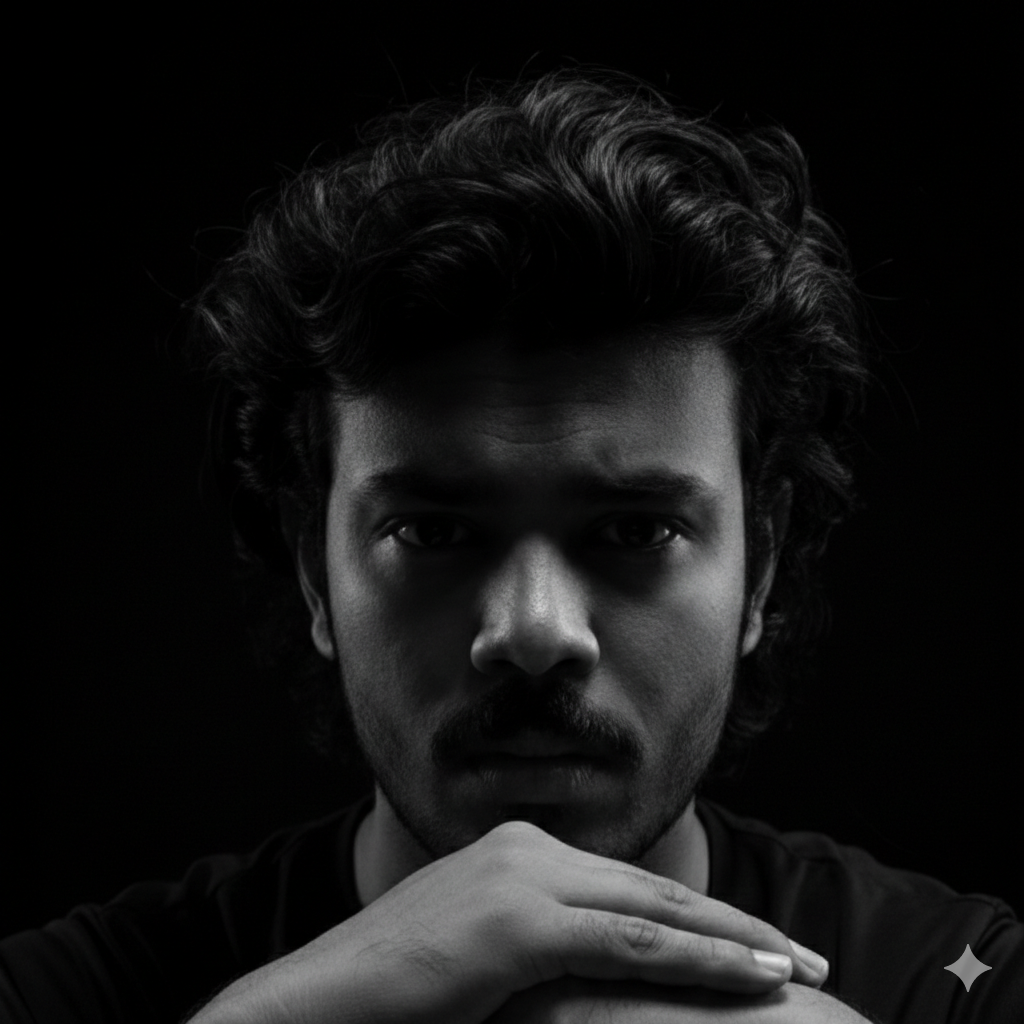
Physics · Philosophy · Systems
Your thinking shapes your life. Most people never fix it.
I rebuilt my mind through physics, philosophy, and systems thinking — after years of anxiety, overthinking, and confusion. Now I document that process publicly, so your thinking becomes clearer, sharper, and more useful.
Clarity of Thought
Mental frameworks that cut through confusion — not motivation, but structure. You’ll leave with tools, not feelings.
Better Decisions
Physics-trained thinking applied to real life. How to reason from first principles instead of inherited assumptions.
Mental Strength
Stoic philosophy — not as quotes, but as a working system for staying controlled under pressure, uncertainty, and pain.
A Different Lens
How entropy, feedback loops, and emergence describe human behavior. Science as a way of seeing — not just a subject.
“Most people consume ideas.
Very few build systems from them.
That gap is where I work.”
Deep thinking
for real life.
I moved toward philosophy because I needed to understand life — not just describe it. Stoicism gave me something physics didn’t: a framework for the internal world. For how to think when things fall apart. For how to remain controlled when others aren’t.
I study epistemology because I question what I actually know. Decision theory because I want to act rationally, not just reactively. This is philosophy as a daily operating system — not as academic decoration.
Read philosophy essays →Stoicism
Control what you control. Act from reason. Remain steady. Not passivity — precision applied to the internal world.
Epistemology
How do you know what you know? Most beliefs are inherited. Examining the source of knowledge changes everything downstream.
Decision Theory
Most bad outcomes come from flawed thinking processes, not bad luck. Philosophy gives you the framework to decide consistently well.
“Discipline is unreliable.
Design is permanent.
Build systems, not habits.”
Clarity over motivation.
Systems over random effort.
A system produces consistent results without relying on willpower. I build and document frameworks for thinking, deciding, and acting — tools that work even when you’re not at your best.
Thinking Frameworks
Mental models that cut noise. How to approach problems before trying to solve them — structure first, action second.
Decision Systems
Structured approaches to making better choices — especially under pressure, uncertainty, or conflicting information.
Execution Design
Building environments where the right action is the natural one. Remove friction. Remove dependency on motivation.
Clarity Systems
Moving from confusion to direction through honest observation — not through feeling better, but through seeing clearly.
“Physics taught me that everything follows rules —
even human behavior.
Find the rules. Work with them.”
Understanding how
reality works — then
using that to live better.
Physics didn’t just teach me equations. It taught me how to think. Strip every problem to its foundations. Question every assumption. Look for the underlying structure before drawing conclusions.
That mindset now shapes how I approach everything: decisions, relationships, habits, meaning. Science isn’t a subject here — it’s a lens.
Systems move toward disorder without deliberate maintenance. Your focus, relationships, and clarity all decay without input.
Small consistent inputs compound over time. The question isn’t what to do once — it’s what loop you’re inside.
Strip every problem to its foundational truths, then reason up from there. Not from convention — from ground zero.
Complex behavior arises from simple rules applied consistently. Character isn’t born — it emerges from repeated choices.
“I write to understand —
not to perform.
These ideas are still being tested.”
Ideas in progress.
All essays →The difference between understanding and knowing
Most people mistake familiarity for understanding. They’ve heard the idea, nodded along — and moved on. But hearing something is not the same as grasping it. Real understanding changes behaviour. Mere knowledge only changes conversation.
Read essay →Stoicism is not emotional suppression
The most common misreading — and why it matters for how you actually practice it.
Read essay →Why your habits keep failing you
It’s rarely about discipline. It’s almost always about design.
Read essay →First principles: how a physicist thinks about life
Physics trained me to strip problems to foundations. This is what that actually looks like in practice.
Read essay →On confusion as a starting point
Confusion isn’t a problem to solve immediately. Sometimes it’s information worth sitting with.
Read essay →What Marcus Aurelius was actually practicing
Reading Meditations wrong is easy. Understanding what he was actually doing takes more attention.
Read essay →
Available on Kindle · Free on Kindle Unlimited
Can’t Break Me
A Stoic Guide for the Modern World
When chaos hits, most people break. This book is a practical guide to staying whole — drawing from Marcus Aurelius, Seneca, and Epictetus, applied to real modern problems. Not a textbook. A survival manual built from real transformation.
I don’t write to impress.
I write to understand.
And sometimes — so do you.
The person behind this
Adil
Bin A V
Physicist · Philosopher · Builder
I studied physics — not because it was safe, but because I needed to understand how things actually work at the most fundamental level. Physics gave me something most education doesn’t: a method. Break everything down. Question every assumption. Build understanding from the ground up, not from authority.
For a long time, I was socially anxious, internally confused, and overthinking everything. I was consuming ideas constantly but not integrating any of them. I had information but no direction. Intelligence but no clarity. I knew things — I understood very little. That gap was painful.
I found Stoicism — not as a self-help trend, but as a genuine system for the internal world. Combined with the physics mindset, I started building frameworks instead of just consuming them. I observed myself and others like systems. I tested what actually changed behavior versus what just sounded good. Slowly, something shifted.
I’m more controlled, more self-aware, and more strategic than I’ve ever been. But I also feel that transformation creates a kind of distance — you start seeing systems in everything, including people, which changes how you operate. I’m building this website as a public record of that thinking — not to teach from a pedestal, but to document the journey honestly as it happens.
Writing (essays, books). Learning (machine learning, math, data science). Content (YouTube, long-form). Digital products. Experiments in business and systems. Not one thing — a system of outputs. This isn’t a brand. It’s a personal operating system — built in public, updated continuously.
If this resonates
Pick one idea.
Think it through.
No newsletters. No transformation promises. Just structured thinking — written honestly, when it’s ready.
If your thinking improves from being here, that’s enough.